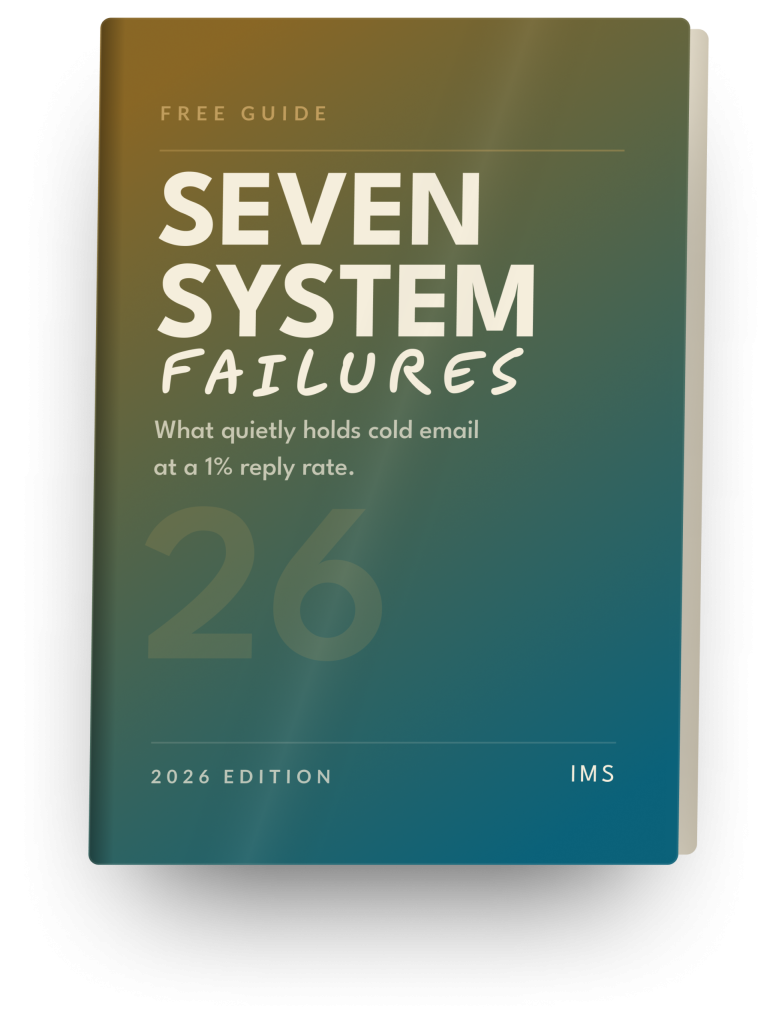
SEVEN SYSTEM

FAILURES

can hold cold email at a 1% reply rate before anyone reads the copy.

For B2B teams using cold email and LinkedIn outbound.

This guide breaks down the seven mistakes that quietly limit delivery, engagement, and replies, including why rewriting the message is usually the wrong place to start.

Sent directly to your inbox. No spam. Unsubscribe in one click.

what's inside

Seven mistakes.

Seven places your outbound can fail before the reply.

Each mistake gets one page in the guide. Here is what to look for. The fixes stay inside.

01

Skipping the deliverability infrastructure

Your sending dashboard says the email was delivered. That does not mean it reached the primary inbox or was seen by the person you selected.

02

Running 2026 outbound on a 2019 playbook

A perfect-fit account with no reason to act is still a cold account. Most lists cannot distinguish it from a company that has just entered a buying window.

03

Counting opens as evidence of interest

A reported open can come from a privacy system rather than a person. The number looks precise while telling you very little about buying intent.

04

Building lists on firmographic fit alone

The right industry, company size, and job title can still produce a list of people with no reason to speak with you this quarter.

05

Sending one message to every account

Adding {{first_name}} and {{company}} changes the fields. It does not change the relevance of the message.


06

Leaving replies without a handling protocol

An interested reply starts losing value as soon as it arrives. When ownership, routing, and response time are unclear, qualified conversations stall.

07

Building lists on firmographic fit alone

The first email asks for attention at one moment in time. A one-touch sequence treats silence as a final answer

Want the fixes?

The full breakdown is inside the guide.

WHY THIS MATTERS NOW

Why the year
is in the title

The old cold-email playbook was built around three assumptions: an open came from a person, a click came from a prospect, and a technically sent email had a fair chance of reaching the inbox.

Those assumptions
no longer hold.

Apple Mail Privacy Protection can download remote email content in the background, whether or not the recipient engages with the message. That makes open data unreliable as a measure of human attention.

(Apple)

Google now applies defined authentication requirements to senders, with additional SPF, DKIM, and DMARC requirements for domains sending at bulk volume. Yahoo also requires authentication and expects spam complaint rates to remain below 0.3%.

(Google Help)

Microsoft added its own requirements for domains sending more than 5,000 messages per day to Outlook consumer addresses. Enforcement began on May 5, 2025, with non-compliant messages routed to junk.

(TechCommunity.Microsoft.com)

By 2026, these are not upcoming changes. They are the environment your campaigns operate inside.

The teams still using 2019 tactics did not suddenly become worse at writing. The infrastructure, measurement, and filtering rules changed around them.

This guide is written for the system as it works now.

Proof

At the top 10 US banks, one fraud, risk, AML, KYC, and identity-theft persona pull produced approximately ~2,400 possible contacts. Citi alone produced 605. IMS scores the contacts within each company and selects the strongest 15 to 20 instead of emailing the entire list.


Built by David March,
Engagement Engineer at IMS.

David designs and runs the systems covered in this guide, including
deliverability infrastructure, persona-based targeting, buying-signal
scoring, reply handling, and the measurement layer that separates activity
from real engagement. The IMS campaign lifecycle carries that work from
ICP intake through qualified sales handoff.

The mistakes are visible once
you know where to look.

The guide shows you what to check, what the numbers are hiding, and what needs to change before you rewrite another email.

Sent directly to your inbox. No spam. Unsubscribe anytime.