Download confirmed
Done. The guide is on its way to your inbox.
Give it two minutes. If it is not there, check your spam or promotions folder. Then move it to your primary inbox so the next email lands where it should.
Fitting, given mistake number one.
While you wait
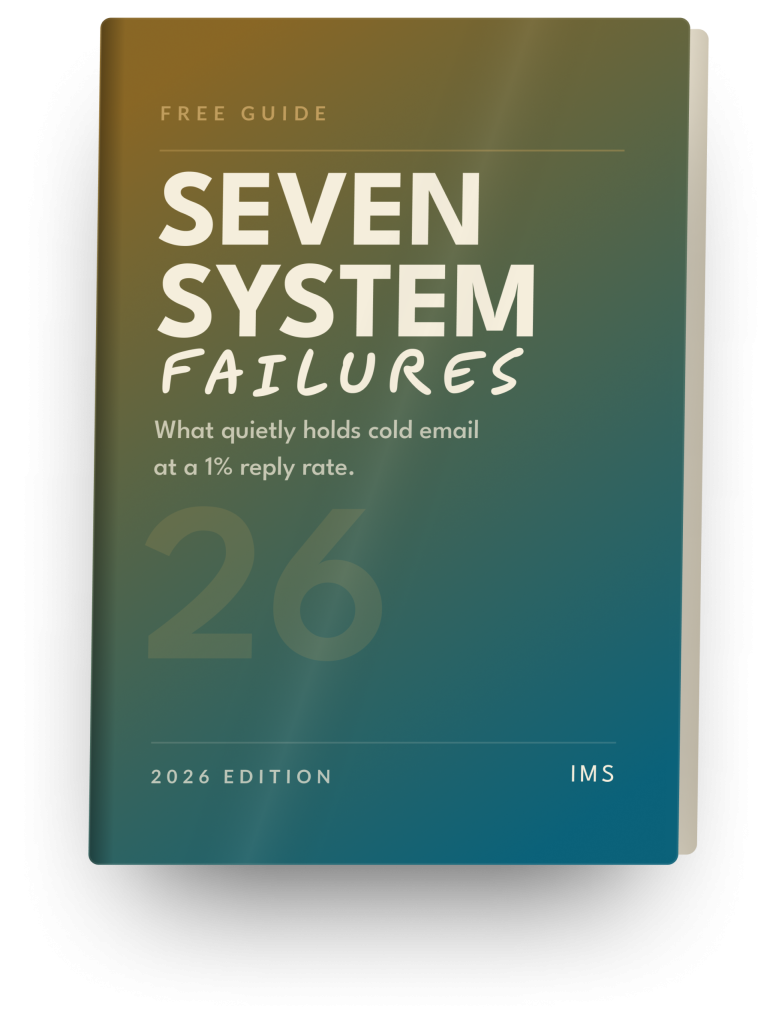
Now that you know what is broken, what should you run instead?
The guide names the seven mistakes. Naming them is the easy part. The next question is harder: what does cold outbound look like when those mistakes are removed?
- Knowing your deliverability is weak does not rebuild the sending infrastructure.
- Knowing your list is too broad does not tell you which accounts have a reason to act now.
- Knowing opens and clicks can be distorted does not give you a measurement system that separates real engagement from automated activity.
That is the difference between reading about an outbound system and having one you can actually run.
The industry default is still a volume play: send more emails, accept a 1% to 3% reply rate, and sort through the noise afterward.
A targeted system takes the opposite approach. It sends fewer emails to contacts selected by fit, seniority, timing, and buying signals, then routes the resulting engagement into a clear next step.
The full 40-page playbook
$9
Instant download
All 12 buying signals, the tools and their real costs, the deliverability stack step by step, and the email variants matched to each signal.
The guide showed you the seven mistakes. This is the complete system for avoiding them, including the infrastructure, targeting logic, workflows, and measurement process behind the campaign.
Better copy cannot rescue a broken system.
Most cold-email teams accept reply rates between 1% and 3% while sending anywhere from 100,000 to more than 1 million emails.
The issue is rarely one isolated mistake. Deliverability, targeting, timing, measurement, personalization, reply handling, and sequence design compound. Fixing the fundamentals changes the campaign before the copy ever reaches the inbox.
IMS campaigns are built through a structured lifecycle covering ICP refinement, asset selection, custom list building, buying-intent scoring, copy, infrastructure, reply handling, analytics, and sales handoff.
© 2026 IMS
Privacy